Almost every decision about hospital artwork gets made by someone standing up, in good light, looking at a wall from six feet away.
Almost nobody who sees the finished work is doing any of those things.
That gap is the single most common problem with art in healthcare buildings, and it is a selection problem more than an installation one. Here is how to close it.
Start with Who is Looking, and from Where
Standard practice puts the center of a work somewhere around 57 to 60 inches from the floor. That number assumes a standing adult, which is the right assumption in a gallery and the wrong one in most of a hospital.
- A person in a waiting room chair has an eye height closer to 45 to 50 inches. Work centered at 60 sits above their natural line for the entire wait.
- A patient in a bed is lower still, and often reclined, so the relevant sightline is partly upward and rarely square to the wall.
- A patient in a treatment or infusion chair is fixed in place and facing one direction, which makes the wall in front of them the only wall that matters.
The practical instruction is simple. Before deciding placement, sit down where the patient will be, or lie back, and look. It takes a minute and it changes the answer more often than not.
We know the standing measurement is wrong because we are the ones who get called back to move it.
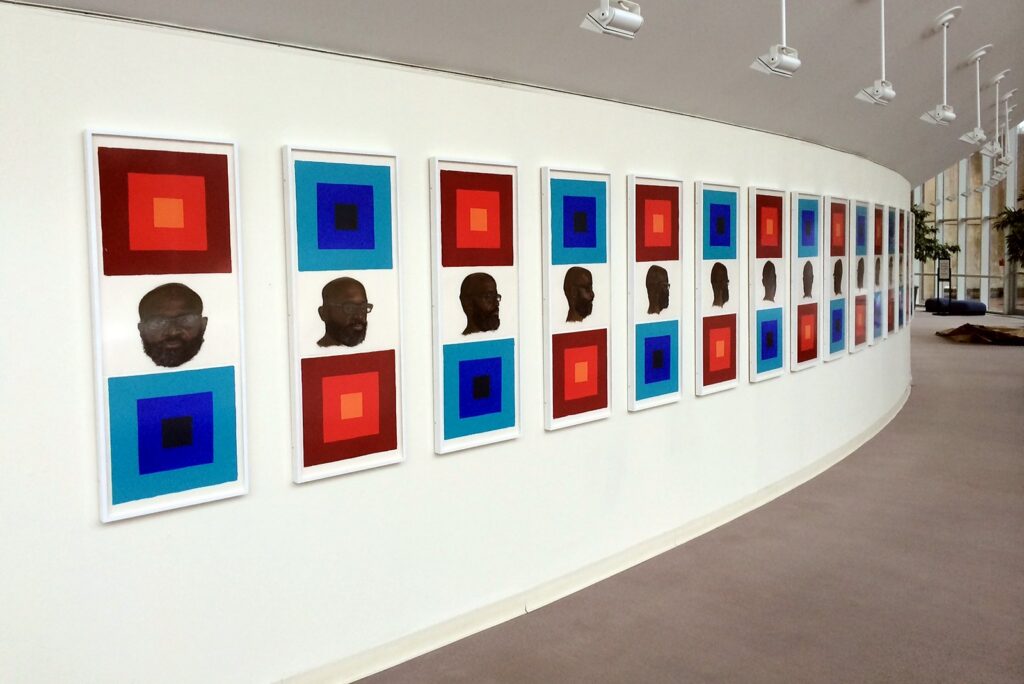
Framed prints installed in a continuous series along a curved gallery wall.
Match the Work to the Time Spent Viewing it
Healthcare spaces have wildly different dwell times, and that should drive selection more than it usually does.
- Corridors: a few seconds, at an angle, in motion. Detail is wasted. Horizontal formats and strong simple structure read better than anything that rewards study.
- Waiting rooms: twenty minutes to two hours, seated, with nothing else to do. This is where a work has to hold up to prolonged looking. Anything clever tends to wear out.
- Treatment and infusion bays: hours, repeatedly, sometimes weekly for months. The highest bar in the building. The same patient will see the same piece dozens of times.
- Patient rooms: days, from a bed. Quiet work, low contrast, nothing that becomes a face at three in the morning.
The test is not whether a piece is good. It is whether it is still good on the fortieth viewing.
What the Evidence Supports about Subject Matter
Art in hospitals gets defended with broad claims about healing. The actual research is narrower and more useful.
Let’s take a look at evidence-based design, anchored by the pioneering work of Roger S. Ulrich, Ph.D., EDAC, professor of architecture at Chalmers University of Technology in Sweden.
Anchored by Dr. Ulrich’s work, The Center for Health Design finds that “well-designed physical settings play an important role in making hospitals safer and more healing for patients ,and better places for staff to work.“, with specific support for nature imagery, daylight, good acoustics, and appropriate lighting.
Read that carefully, because it is not the same as “art helps.”
Representational nature imagery has the strongest backing. Landscapes, water, trees, open views. Ambiguous and abstract work has weaker support in patient care areas, where anxious or medicated people do not reliably find open-ended imagery calming and sometimes find it the opposite.
This does not mean a healthcare collection has to be landscapes. It means patient areas and everywhere else are two different briefs.
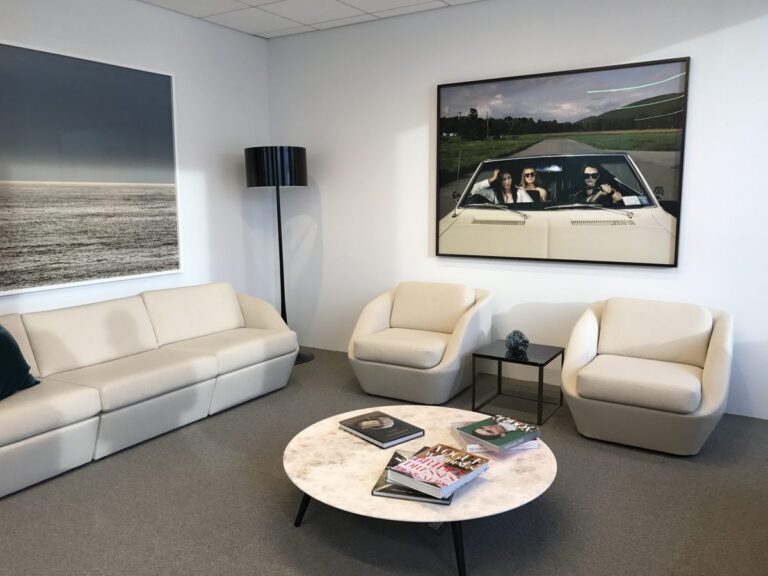
Relaxed, horizontal art chosen for calming waiting room.
Ready to Install Your Collection?
ILevel has installed artwork in New York offices, lobbies, and corporate collections since 1990.
Whether it is one reception wall or a collection across a dozen floors, we’re excited to work with you!
Two Standards, Not One
Most healthcare collections are selected as though the whole building were one environment. It is not.
Patient-facing areas carry the evidence-based constraints above. Calm, legible, durable to repeat viewing.
Staff lounges, administrative corridors, donor lobbies, and boardrooms are closer to a corporate collection. Abstraction works. Ambition works. The audience is not under stress and is not captive.
Applying the patient-area standard everywhere produces a building full of pleasant, forgettable work. Applying the lobby standard everywhere puts difficult art in front of people having the worst week of their year.
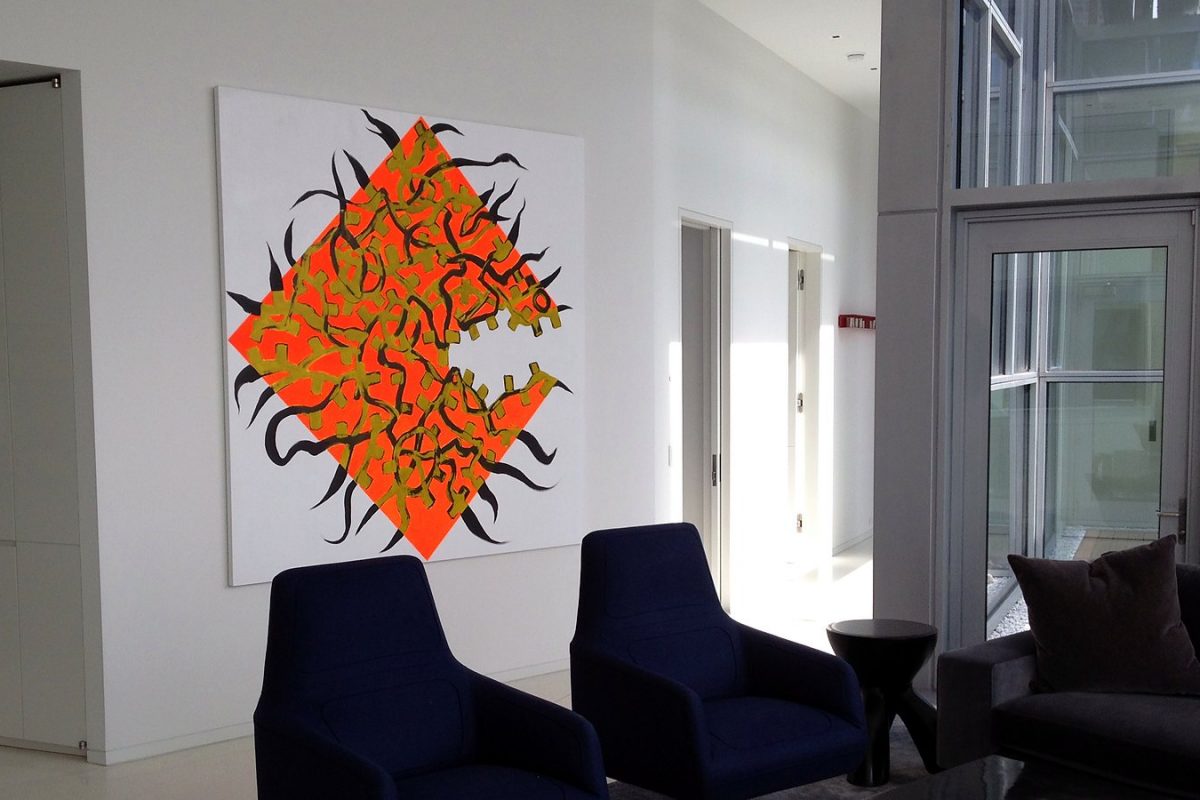
Large artwork installed above seating in a waiting room.
Think in Series, Not in Pieces
Healthcare buildings repeat themselves. Twenty identical exam rooms, four identical floors, a corridor that looks the same at both ends.
Single pieces chosen one at a time read as arbitrary in that context and become an inventory problem later. A series, or a set of related works, gives a floor coherence, makes wayfinding possible, and means a piece can move between rooms without looking out of place.
It also makes the collection easier to grow. Adding to a series is a decision anyone can make later. Matching a one-off is not.
Select for the Cleaning Cart
A short list, best raised early, since each one has killed a selection late in a project.
Corridor pieces cannot project into required clear egress width. Areas near imaging equipment restrict what hardware can be used. Behavioral health units have their own mounting and glazing standards that belong with the facility’s safety officer. And artwork in a healthcare facility usually passes through more approvals than people expect, including facilities, infection prevention, and sometimes a patient experience committee or donor relations.
None of these are obstacles. They are just faster to handle at selection than at installation. Our piece on hospital art installation covers each of them in full, along with what to look for in an installer.
Talk to Us!
ILevel has installed artwork in New York hospitals, medical offices, and healthcare systems since 1990, working alongside facilities teams, art consultants, and design firms.
A piece chosen without checking the wall is usually a piece chosen twice, which is the whole argument for bringing an installer into the conversation before anything is bought.
If you are planning a collection, or trying to work out whether what you have chosen will work where you want it, request an estimate and we will take a look.
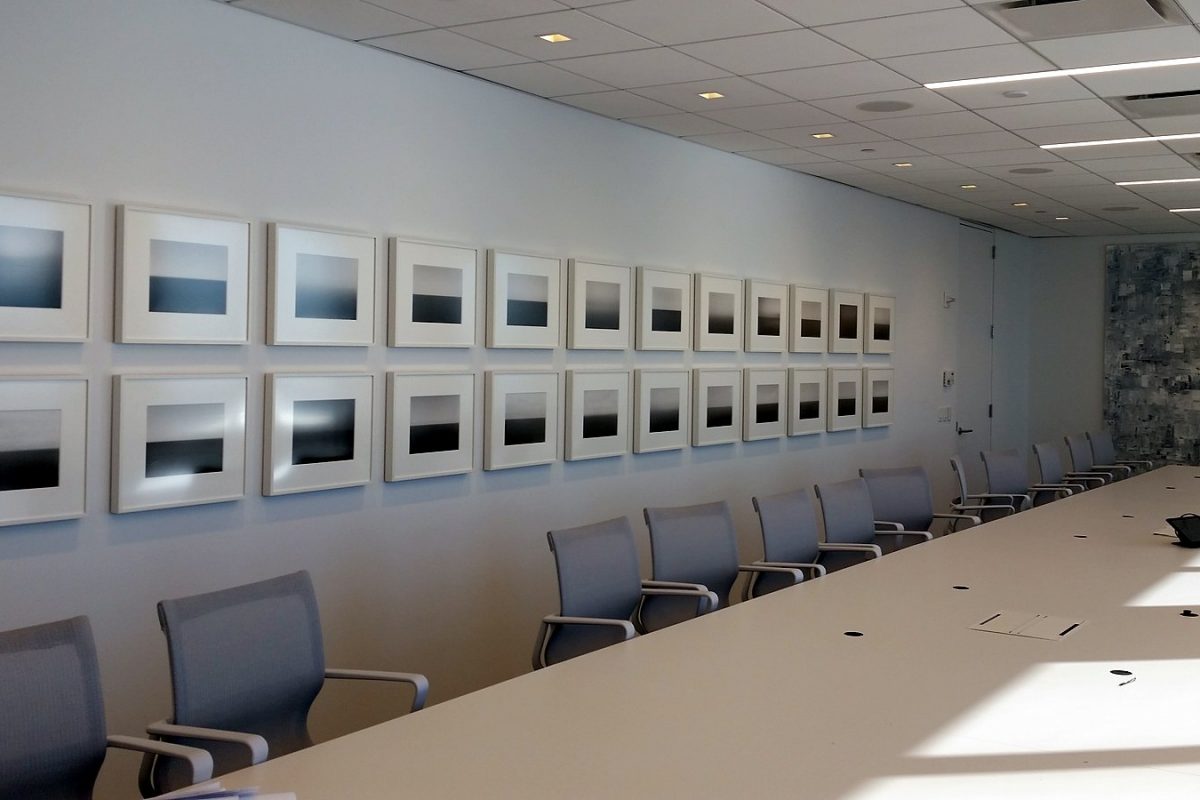
Two rows of framed horizon photographs installed along a boardroom wall.
Reach Out to Schedule Your Project
Contact us today for a project estimate or to schedule a site visit. We’re here to answer any questions.
Frequently asked questions
What height should artwork be installed in a healthcare facility?
Lower than the gallery standard in most patient-facing areas. The usual convention centers a work around 57 to 60 inches from the floor, which assumes a standing viewer. In waiting rooms, treatment bays, and patient rooms the person who looks longest is seated or reclined, with an eye height closer to 45 to 50 inches or lower. The reliable method is to sit or lie where that person will be and set the sightline from there rather than from a standing measurement, since bed heights, chair types, and room geometry vary too much for a single number.
What kind of artwork works best in patient areas?
Research on evidence-based design most strongly supports representational nature imagery, including landscapes, water, and trees, along with daylight and good lighting. Ambiguous or abstract work has weaker support in patient care settings, where anxious or medicated patients may find open-ended imagery unsettling rather than calming. Dwell time matters as much as subject. A piece in an infusion bay may be seen by the same patient weekly for months, so it needs to hold up to repeat viewing rather than make a strong first impression.
What should healthcare facilities consider when choosing artwork?
Start with sightlines and dwell time, since those determine placement and scale more than wall dimensions do. Then separate patient-facing areas from staff, administrative, and donor spaces, because the two call for different selections. Consider maintenance at the point of purchase, including glazing, frame profile, and whether surfaces tolerate hospital-grade disinfectants. Finally, allow time for approvals, since artwork commonly passes through facilities, infection prevention, and sometimes a patient experience committee or donor relations before anything goes on a wall.
How should artwork be installed in a healthcare facility?
Securely, cleanably, and with impact in mind. Mounting should be rated well above the weight of the piece and chosen to resist contact from beds, gurneys, and carts rather than gravity alone. Work in corridors must not project into required clear egress width. Areas near imaging equipment restrict the hardware that can be used, and behavioral health units have their own mounting and glazing standards that should be set with the facility's safety officer. In an occupied building, work is scoped into short contained blocks timed around unit activity rather than after hours, since a hospital never closes.
How do you choose artwork for a hospital waiting room?
Choose for a seated viewer with time on their hands. Waiting rooms have long dwell times and a captive audience, so work needs to reward extended looking without demanding it. Set the sightline from a chair rather than from standing height. Favor calm, legible imagery over anything ambiguous, since people in a waiting room are frequently anxious. Scale to the viewing distance across the room, and consider a series rather than a single piece if the room is large or the seating faces more than one wall.